

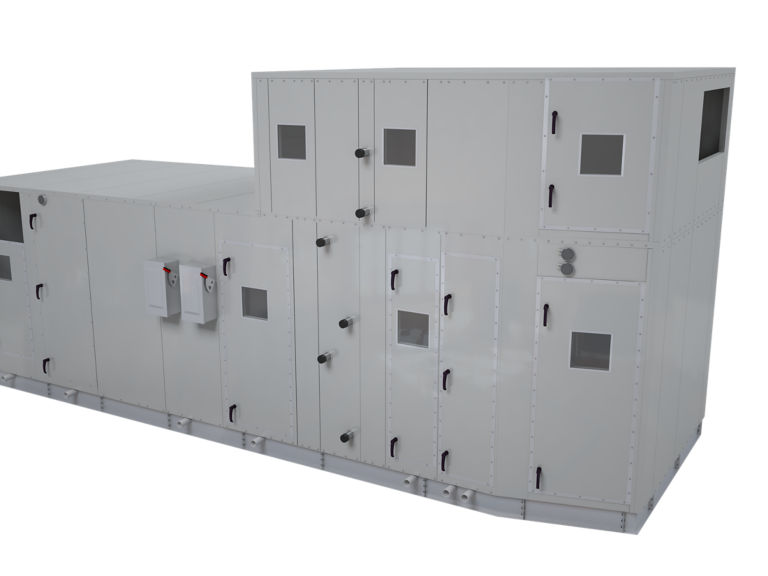
This requirement generally applies to two types of systems: dedicated (100-percent) outdoor-air systems and mixed-air systems that serve spaces with high minimum requirements for outdoor airflow (for example, densely occupied spaces). Of course, exhaust-air energy recovery may make economic sense for systems that deliver 40-percent or less outdoor airflow by permitting equipment downsizing and consuming less new energy.
Standard 90.1 mandates a minimum effectiveness of 50 percent when exhaust-air energy is required. (The inset on p. 4 lists the exceptions to this requirement; effectiveness is discussed on pp. 6 – 7.) As defined by the standard, Fifty percent energy recovery effectiveness shall mean a change in the enthalpy of the outdoor air supply equal to 50% of the difference between the outdoor air and return air at design conditions.
Further, the exhaust-air energy-recovery system must be installed with bypass dampers or other controls that permit airside economizer operation when such economizers are prescribed by Section 6.5.1.1 of the standard.
Section 6.5.2 of Standard 90.1 also relates to the use of energy recovery; it limits coincident heating and cooling of the same air stream. According to Section 6.5.2.3, if space humidity is directly regulated — through the use of humidistats, for example — controls must prevent reheating, mixing of hot and cold air streams, or other means of simultaneously heating and cooling the same air. (The inset on p. 4 lists the exceptions to this requirement.) Exception E permits reheat if at least 75 percent of the energy used to reheat the air is recovered on site.
Limiting the use of “new” energy for reheat will almost certainly prompt HVAC design professionals to recover heat from the cooling process when reheat is required, particularly in dehumidification applications. Potential sources of recoverable heat include:
- Condenser water in a water-cooled, chilled water system
- Hot refrigerant in a refrigeration system
- Another air stream or another location in the same air stream.
The rest of this manual describes how air-to-air heat exchangers can be used to transfer energy within or between air streams.

